
Cullman County Probation and Parole
Probation and parole both place a released person under rules, reporting, and possible return-to-custody consequences. They do not mean the same thing. Probation normally comes from the sentencing court and can begin without a state-prison stay. Parole usually follows a state-prison sentence after action by the Alabama Board of Pardons and Paroles. In Cullman County, the state supervision agency is the Alabama Bureau of Pardons and Paroles, often shortened to ABPP.
A person released from Cullman County Detention Center may be finished with jail custody but still have a probation order, a split sentence, a parole matter, or a court hearing ahead. The jail release record shows the person left local custody. It does not prove supervision has ended. The durable supervision trail is the court order, ABPP record, parole hearing result when parole was involved, and any revocation or delinquency case filed later.
| Record type | What it means in Cullman County | Where to verify |
|---|---|---|
| Probation | A court-ordered sentence or condition served in the community under supervision. | Cullman County court record, sentencing order, and ABPP field office. |
| Parole | Release from state-prison custody to supervision after board action or related state process. | ABPP hearing calendar, parole results, Public Information Unit, and local office. |
| Mandatory or post-release supervision | A supervision term tied to Alabama sentence rules or release conditions. | ADOC record fields, ABPP, and sentencing documents. |
| Discharge | The supervision term has ended or the sentence has fully expired for that agency. | ABPP or court record, depending on the sentence. |
- Parole
- Conditional release from prison before the full sentence expires, supervised under state parole rules.
- Probation
- A court sentence or condition that allows the person to remain in the community while following court and supervision terms.
- Absconder
- A supervised person who is alleged to have stopped reporting or left supervision without approval.
- Discharge
- The end of custody or supervision for a specific sentence or agency record.
Verify Cullman County Supervision
Cullman County supervision verification works best when it starts with the event that caused release. A county jail bond release points to the court and jail record. A state-prison release points to ADOC and ABPP. A parole consideration date is not a release date, and a probation order is not the same as a jail discharge. Use the Cullman County released inmates search path for the custody event, then use the supervision path for conditions that continue after release.
- Identify whether the person left county jail, ADOC state custody, or federal custody. Cullman County Detention Center also houses municipal and U.S. Marshals detainees.
- Check the court case for a probation order, split sentence, revocation order, bond order, or sentence that explains why supervision applies.
- For state cases, review ADOC fields such as Parole Consideration Date, Parole Status, and Minimum Release Date when the person is still in ADOC custody.
- Use ABPP resources for parole hearing dates, hearing outcomes, eligibility questions, and local supervision routing.
- Contact the Cullman Field Office when the question is local supervision in Cullman County, not a jail roster or court-record copy.
- If a release alert matters, use VINELink Inmate Search or Alabama VNS, then verify the record with the custodian.
ABPP's Public Information Unit is useful when the question is statewide and case-routing related. Research sources say the unit handles questions about eligibility, parole consideration dates, hearing results, inmates granted parole but not yet released, and cases with no consideration date or a date that has passed. ABPP lists 334-242-8700 for the main agency and routes callers through menu options for hearing and release questions.
Cullman County ABPP Office
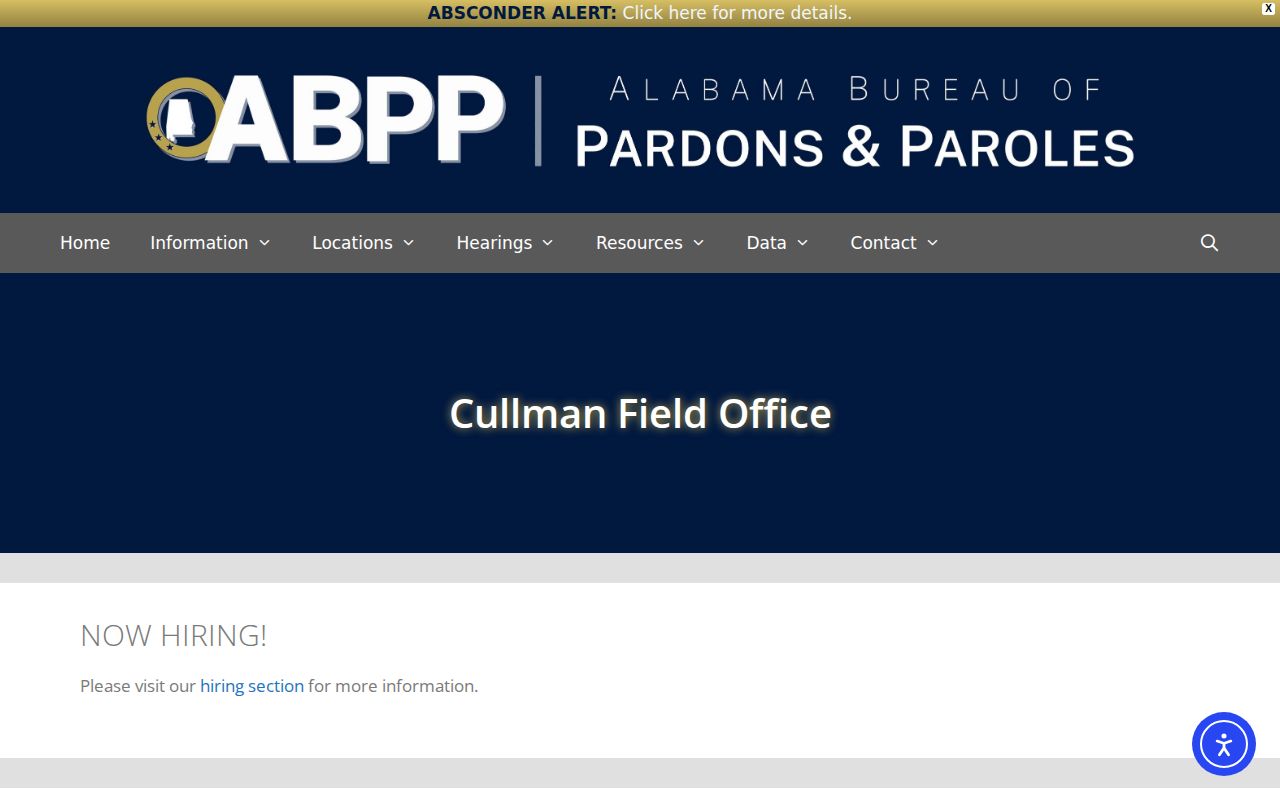
The local supervision office is a key Cullman County fact. The ABPP Cullman Field Office serves Cullman County from the courthouse. That gives a local contact point for parole and probation supervision questions after a release from jail or state custody. It should not be used as a substitute for a jail release record, court disposition, or ADOC public-record request, but it is the correct local office when supervision itself is the issue.
Alabama Bureau of Pardons and Paroles
Cullman Field Office
Cullman County Courthouse, Room 30
500 2nd Avenue SW
Cullman, AL 35055
256-775-4771
Monday-Friday, 8:00 a.m. to 4:15 p.m.; closed noon to 1:00 p.m. and state or federal holidays.
ABPP Public Information Unit
Main agency questions, eligibility routing, hearing-result questions, and cases granted parole but not yet released.
334-242-8700
The manifest includes the ABPP office page for this local contact. The Cullman Field Office source identifies the courthouse office, phone, hours, and county served.
Use the office record to route supervision questions, then use the jail, court, or ADOC record for the underlying release event.
Cullman County Parole Hearings
Parole hearings add another layer to Cullman County parole and probation research. The ABPP General Hearing Information source says parole and pardon hearings are held in open public meeting each week on Tuesday, Wednesday, and Thursday unless noted. The hearing site is in Montgomery, not Cullman, but the outcome can control whether a Cullman-linked state prisoner is granted parole, denied parole, continued, reset for future consideration, or released later with special conditions.
Use the scheduled parole hearings page to see board dockets and the current-year parole results page for decisions. The results archive also publishes grant, deny, and continued outcomes. ABPP notes that a reset date is the first month and year for possible placement on a future docket, not a new hearing date and not a release date.
| ABPP item | How to read it |
|---|---|
| Scheduled hearing | The case is listed for board consideration. It is not a release order. |
| Grant | The board approved parole, but release processing and conditions may still need completion. |
| Deny | Parole was not granted for that board action. |
| Reset or future consideration | The case may be placed on a future docket in the month and year stated. |
| Special conditions | Conditions may appear in minutes or board records and may affect supervision after release. |
Parole eligibility is calculated under Alabama parole law. ABPP's FAQ ties eligibility consideration to Ala. Code Section 15-22-28(e), while Alabama Code Section 15-22-26 says parole is not a reward for good conduct alone. The Board uses criteria, guidelines, and public-safety judgment. That is why a Cullman County projected release question can require both ADOC and ABPP records.
Cullman County Absconder Checks
Conditions are the rules attached to supervision. A person may have to report, remain at an approved address, comply with court orders, follow treatment or programming terms, and avoid new violations. The exact terms come from the sentencing order, parole certificate, supervision plan, or court order. General statements are not enough for a named Cullman County person. The official record controls.
Violation and absconder status should be handled carefully. The research found ABPP navigation for absconder alerts, but it did not capture a working detailed result page. A lack of online data does not prove the person is clear, and a rumor does not prove a warrant. For a named Cullman probationer or parolee, use ABPP, the court record, and warrant-related court contacts rather than assuming status from a public search gap.
VINELink and Alabama VNS can help with custody-change alerts, especially for ADOC-sentenced offenders. Alabama VNS states that it is only for offenders convicted in Alabama and sentenced to prison. For a pretrial Cullman County jail case, the VNS site directs inquiries to the sheriff in the county where the crime occurred. That makes the Cullman detention record and court record essential when the person never became an ADOC prisoner.
Note: A supervision violation can lead to arrest or custody without changing the original release record into a new conviction.
Cullman County Work Release
Cullman County has a documented work-release program. The sheriff's warden page says the detention center has an active program for both male and female inmates, with participants vetted and classified as suitable. The same local context appears in the sheriff audit report, which identifies a Work Release Fund for participant wages. This is release-adjacent, but it is not final release.
A person in the Cullman County Detention Center Work Release Program may be outside the jail during approved work periods while still remaining in custody. Final release still depends on the sentence, bond, court order, transfer, discharge, or supervision handoff. If supervision follows, the release trail may move from the jail record to ABPP or the court. If there is a dispute about timing, request the jail release entry and, where relevant, ask how work-release wages or property return were recorded.
Cullman County Supervision Discharge
Supervision ends by discharge, expiration, court action, parole action, revocation, or another order that changes the case. A jail release date is not the same as the end of supervision. A person may leave Cullman County Detention Center and still be required to report to ABPP. A state prisoner may reach an ADOC Minimum Release Date and still have parole or other supervision terms. A probationer may complete a court-ordered term without ever having a parole hearing.
Alabama public-record law supports requests for public records, but sealed, expunged, juvenile, youthful-offender, active-investigation, and other restricted records may not be available in ordinary public channels. For a final supervision check, ask the right custodian for the right document: ABPP for supervision status, the court for sentencing and probation orders, ADOC for state release records, and the sheriff for Cullman jail release entries.