
Cullman County Projected Release
A projected release date is a planning date, not a guarantee. In Alabama prison records, the central term is ADOC's Minimum Release Date. ADOC defines it as the earliest scheduled date an inmate can be released to probation or end of sentence. That wording matters because readers may call it a projected, scheduled, tentative, or expected release date, but the ADOC field has its own meaning.
The actual release date is the date the person leaves a custody setting or transfers out under another authority. A person can have an expected date and still remain in custody because of disciplinaries, loss of good time, a new case, a sentence change, a detainer, a court order, a parole decision, or administrative processing. In Cullman County, a county-jail release may also be shaped by bond posting, a judge's order, jail credit, municipal or district court action, or transfer to ADOC, USMS, BOP, ICE, or another agency.
Find Cullman County Release Dates
The first step is not a database search. It is custody classification. Cullman County Detention Center holds county pretrial defendants, misdemeanor defendants, municipal arrestees, and U.S. Marshals detainees. ADOC handles state-prison custody. ABPP handles parole and probation supervision. Each system uses different records, so one search will not answer every release-date question.
- Start with the custody type. County jail, state prison, municipal case, and federal housing each have a different release-date source.
- For an ADOC prisoner, search the Alabama Department of Corrections inmate search by AIS number first, then by name.
- Read Minimum Release Date separately from Parole Consideration Date and Parole Status. These fields do different jobs.
- For a Cullman County jail sentence, contact Cullman County Detention Center and check the sentencing or bond order in court records.
- For municipal cases, use the City of Cullman Municipal Court record process when the city court holds the relevant case file.
- For parole questions, use ABPP hearing records, results, and the Cullman Field Office rather than treating a parole date as a release date.
- For a release alert, register with VINELink Inmate Search when the person appears in a participating custody system.
The Cullman County released inmates search path is still needed after a projected date passes. If the person is no longer visible in ADOC's current-inmate search, that absence is not a complete historical release record. ADOC says its public search contains currently incarcerated inmates and does not provide historical data online. After release, ADOC records requests, ABPP supervision records, court records, VNS notices, and the jail release entry become more important.
ADOC Minimum Release Date
The ADOC public inmate search is useful for a current state prisoner tied to Cullman County, but it is not a complete released-person archive. ADOC says the AIS number is a unique six-digit number and takes precedence over name fields. First and last names can be searched separately or together, name searches are open-ended, and results are limited to 50 at a time. Youthful Offender Act inmates are not included.
| ADOC field | How it affects a Cullman release-date check |
|---|---|
| AIS number | Best identifier for a state prisoner when known. |
| Minimum Release Date | Earliest scheduled release to probation or end of sentence, subject to change. |
| Parole Consideration Date | A tentative board consideration date, not a promised release. |
| Parole Status | May show parole, delinquent, or revoked status after a release event. |
| Current custody result | Confirms current ADOC custody, but missing results do not provide historical release proof. |
The manifest includes ADOC's definitions page for the Minimum Release Date field. The ADOC definitions source is the correct reference for Alabama's wording.
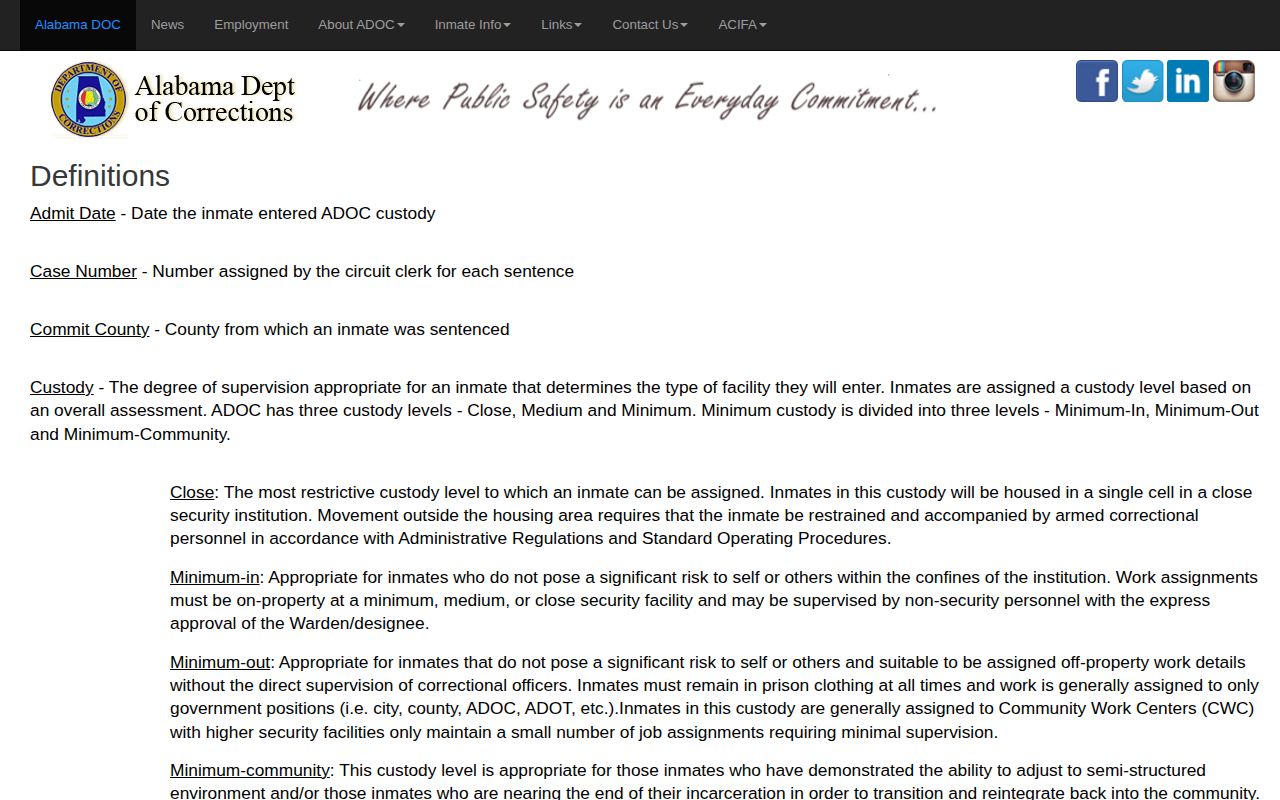
Read the ADOC date as a scheduling field. Confirm the final release through ADOC records, ABPP supervision records, VNS notice, or the court file when the person leaves custody.
Cullman County Good-Time Rules
Alabama correctional incentive time, often called good time, is governed by Alabama Code Section 14-9-41. The statute allows eligible prisoners to earn deductions from the term of sentence by classification. Class I earns 30 days for each 30 days served, Class II earns 15 days for each 30 days served, Class III earns 5 days for each 30 days served, and Class IV earns no correctional incentive time. A higher classification is not retroactive to earlier periods.
Not every person can earn correctional incentive time. Section 14-9-41 excludes several categories, including Class A felonies, crimes causing death by deadly weapon, life or death sentences, sentences over 15 years, and child-involved sex offenses as defined by statute. It also bars Class I placement for certain assault, child sexual-abuse, and violent Class B felony convictions. That means a Cullman County projected release date cannot be computed from sentence length alone.
The same law explains who administers the rule. ADOC administers it for state penal institutions, the sheriff administers it for county jail prisoners, and the chief of police administers it for municipal jail prisoners. This distinction matters in Cullman County. A short county or municipal sentence can depend on local jail or police administration, while a state-prison sentence relies on ADOC records.
Alabama Parole Date Limits
Alabama release-date research should not say every inmate serves 85 percent. ABPP's parole FAQ says parole eligibility consideration is calculated under Ala. Code Section 15-22-28(e), and that sentence, crime, jail credit, good-time ability, time served, and court orders affect eligibility. Some serious offenses may delay initial parole consideration under an 85 percent or 15-year framework, but that is not universal.
Alabama Code Section 15-22-26 also matters because parole is discretionary. The statute says parole is not a reward for good conduct alone and depends on the Board's judgment under its criteria and guidelines. For Cullman County, this means a parole consideration date can be a board-process date while Minimum Release Date is an ADOC scheduling date. Neither one should be read as final without the later release record.
Why Cullman County Dates Change
Projected release dates move because custody records are live administrative records. The change may come from the jail, the court, ADOC, ABPP, another agency, or a new charge. When a date changes, ask which system changed it and what document supports the change. A court order, sentence amendment, detainer, disciplinary action, parole decision, or transfer record can all explain the difference.
| Change factor | Effect on release date | Where to verify |
|---|---|---|
| Good-time loss | Can move the earliest date later after disciplinaries. | ADOC or jail administration record. |
| New case or sentence change | Can alter sentence length, jail credit, or custody authority. | Circuit clerk, district court, municipal court, or ADOC. |
| Detainer or hold | May prevent community release even when local custody ends. | Jail release record, requesting agency, ICE, USMS, or another jail. |
| Parole grant or denial | Can create release processing or delay release after board action. | ABPP results, Public Information Unit, and local field office. |
| Bond or court order | Can create a county jail release with no fixed advance date. | Cullman County court record and detention center record. |
| Administrative processing | Can affect actual release timing after the legal event occurs. | Detention center, ADOC, or receiving agency. |
Note: No official Cullman policy on release time of day or weekend release timing was found in the research, so confirm timing with the detention center.
Cullman County Jail Timing
A pretrial Cullman County jail detainee usually does not have a projected release date in the way a sentenced ADOC prisoner might. Release can depend on bond posting, a judge's order, dismissal, sentence credit, transfer, or another agency's hold. The sheriff's official pages did not publish a 24-hour or 72-hour release feed, so a same-day release question should go through the detention center and the court case rather than an online list.
For county jail sentences, ask whether the date is based on sentence length, jail credit, court order, correctional incentive time if applicable, or a transfer. For municipal cases, the City of Cullman Municipal Court process may hold the court record, while the county jail holds the booking and release entry. For U.S. Marshals detainees housed in Cullman, the federal court and USMS path may control the release event even though the person was physically held in the county detention center building.
A good Cullman County release-date request should name the person, date of birth if known, booking date, arresting agency, and court or case number. Ask whether the person has a computed jail release date, a bond-release path, a hold, a detainer, a transfer order, or a court order that controls release. If the person is in work release, ask for final release status rather than assuming community movement means discharge.
Confirm Cullman County Release Dates
Release-date confirmation should end with the custodian that owns the record. For a Cullman jail release, contact Cullman County Detention Center and check the court disposition. For a state-prison release, use ADOC records, ABPP if supervision follows, and Alabama VNS if registered. For federal release, use BOP if the person was in BOP custody or federal court and USMS if the person was a pretrial federal detainee.
VINELink is useful for notice. It can alert a registered user that custody changed, but it is not the full jail booking record or court disposition. A release notice should prompt a records check, not replace it. When a date matters, preserve the date source, the agency name, the case number or AIS number, and the time the information was received.
For a state-prison date that has already passed, ADOC's public current-inmate search may no longer display the person. That is where a written ADOC public-record request can matter. ADOC Form 23-A uses a processing fee and asks for written requests to the public-records coordinator. Keep the request narrow: release or discharge date, release reason, facility, sentence end date, parole handoff if applicable, and identifiers such as AIS number and full name.
For court confirmation, use the Cullman Circuit Clerk for District and Circuit Court proceedings and the City of Cullman Municipal Court when the city court owns the municipal case. Court records can show the order that caused release, jail credit, probation terms, dismissal, sentence change, or commitment to ADOC. Those records often explain why a projected date changed or why a person left the jail without appearing in a public release list.